As the United States threatens to obliterate Iran’s energy infrastructure, the world’s biggest question isn’t just whether Tehran blinks – it’s whether Moscow and Beijing will keep watching from the sidelines while America moves to reshape the entire Middle East.
The Ultimatum That Could Change the Middle East Forever
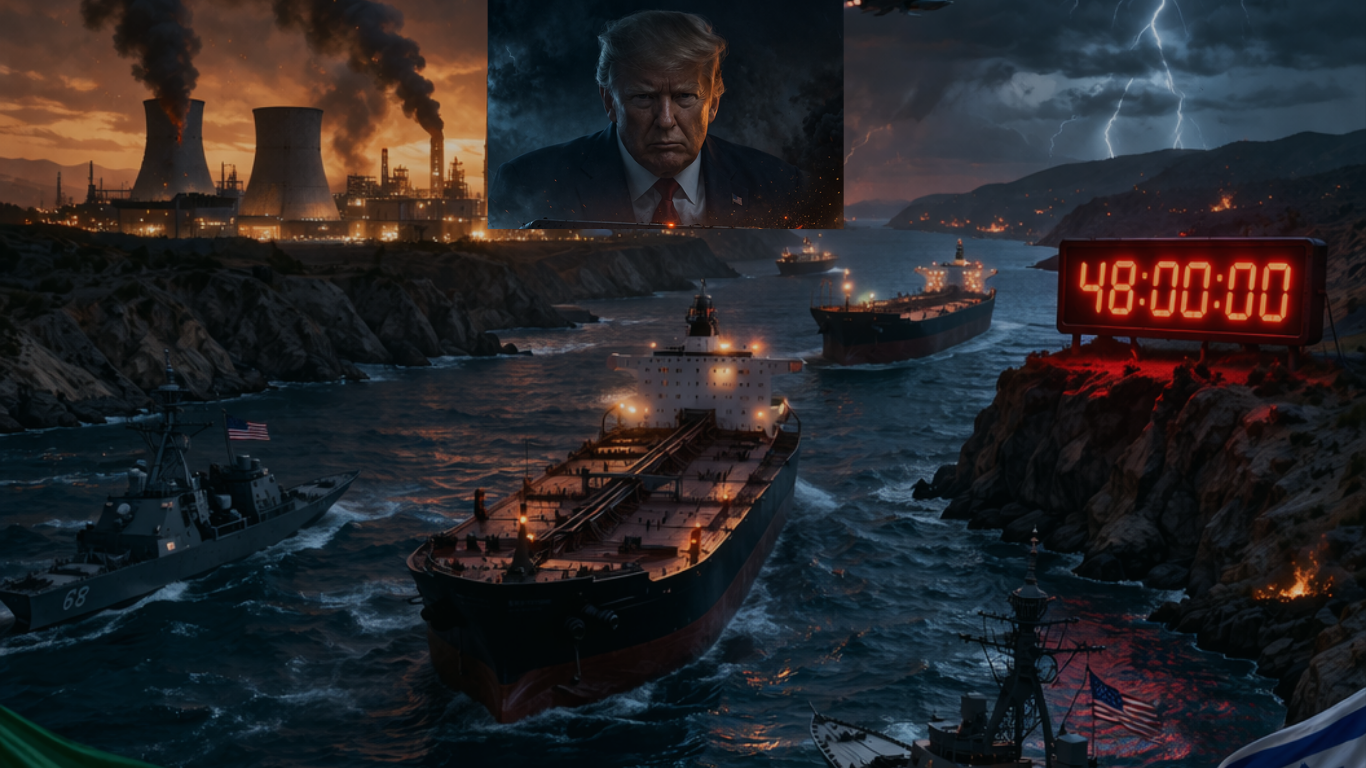
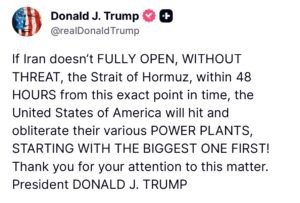
In the early hours of Sunday morning, President Donald Trump posted one of the most consequential ultimatums in modern American foreign policy. The message, delivered on Truth Social, gave Iran precisely 48 hours to fully reopen the Strait of Hormuz – or face U.S. strikes on its power plants, beginning with the largest one. The deadline expires Monday evening, U.S. Eastern Time.
This did not come from nowhere. U.S. and Israeli strikes on Iran began on February 28, 2026, in what Russia’s Foreign Ministry called “a deliberate, premeditated, and unprovoked act of armed aggression against a sovereign and independent UN member state.” Since then, the war has escalated at a pace that has stunned even seasoned regional analysts. The conflict has already killed more than 1,000 people, and has spread to nearly a dozen nations across the already fragile Middle East. Iran’s Supreme Leader Ali Khamenei was killed in the early strikes. Mojtaba Khamenei has since been selected as the new Supreme Leader, with Russian President Vladimir Putin promptly offering congratulations and emphasising Moscow’s continued support for Iran.
On Saturday, the war came directly to Israeli streets. Iranian ballistic missiles struck the southern Israeli cities of Arad and Dimona, wounding nearly 100 civilians – including a 12-year-old boy and a 5-year-old girl – after Israeli air defence systems failed to intercept at least two projectiles. Iran said the Dimona strike was retaliation for an earlier Israeli strike on Natanz, Iran’s primary nuclear enrichment facility. The cycle of retaliation is now spinning fast enough that a single miscalculation could drag the entire region, and the world – into something far larger.
What Iran Has Threatened in Return
Tehran did not receive Trump’s ultimatum quietly. Iran’s military issued an unambiguous counter-warning: if Iran’s fuel and energy infrastructure is struck, all energy, technology, and desalination infrastructure belonging to the United States and its allies across the region will be targeted in retaliation. This is not a vague diplomatic protest. It is a direct military threat aimed at Gulf Arab states – Saudi Arabia, the UAE, Qatar, Kuwait, countries that host American military bases and whose oil and gas facilities feed the global economy. The implications of that domino effect, should it be triggered, are almost incalculable.
The Strait of Hormuz carries roughly 20% of the world’s oil and gas. Its effective closure has already sent international Brent crude futures to $112.19 a barrel – a figure that translates directly into higher fuel, food, and transport costs for billions of ordinary people who have no stake in this conflict whatsoever.
The Russia-China Question: Words Without Weapons
Here lies the story that the world is watching just as closely as the war itself. Iran has long positioned itself within an informal power triangle alongside Russia and China – an axis built on shared hostility toward American dominance, mutual economic dependency, and a string of landmark agreements. In 2021, China and Iran signed a 25-year comprehensive strategic partnership agreement. Russia and Iran signed a 20-year strategic partnership in 2025. In January 2026, all three nations signed a trilateral strategic pact.
On paper, Iran should not be alone. In practice, it very nearly is.
China and Russia have both condemned U.S. and Israeli strikes on Iran. Whether any tangible or impactful support for Iran will materialise is uncertain. Officials from both countries have condemned the strikes but stopped short of pledging military or civilian support to Tehran.
China’s response has been firmly planted in the language of diplomacy. Chinese Foreign Minister Wang Yi told his Israeli counterpart that “force cannot truly solve problems” and called for an immediate cessation of military operations, adding that Beijing “opposes any military strikes launched by Israel and the US against Iran.” Wang urged all sides to avoid further escalation, emphasising that China’s role has evolved into a protective one – accelerating mediation efforts to prevent a regional collapse that would threaten its own economic and security interests. China imports a vast share of its oil from the Gulf. An uncontrolled regional war is an existential economic threat to Beijing, regardless of which side it nominally supports.
Russia jointly requested an emergency UN Security Council meeting with China, condemning the initial strikes as violations of sovereignty. Russia’s Foreign Ministry accused the U.S. and Israel of “plunging the Middle East into an abyss of uncontrolled escalation” and warned of a potential “humanitarian, economic and possibly radiological catastrophe.”
But words at the Security Council are not soldiers on the ground.
As per sources, Russia’s role in the conflict has focused on intelligence sharing and logistical aid, avoiding direct combat to prevent straining its resources amid its ongoing Ukraine conflict. U.S. officials reported that Moscow supplied Iran with real-time data on American warships and aircraft, enabling more precise retaliatory strikes – including satellite feeds from Russian assets. Yet even this level of involvement has its ceiling. Russia is stuck in the morass of its four-year full-scale war against Ukraine and has limited capabilities for broader influence. Russia may try to cause trouble for the United States, but it has definitively demonstrated it is not willing to make significant sacrifices for Iran the way the U.S. is for Israel.
At the UN Security Council, when Resolution 2817 condemning Iran’s attacks on Gulf neighbours was put to a vote, China and Russia abstained rather than vetoing – a telling signal of how far their public solidarity with Tehran actually extends.
The hard truth, as analysts are now openly stating, is that a strategic partnership with Beijing falls far short of a military alliance or even a guarantee of military support, in the face of an existential threat from U.S. aggression. Iran’s leadership is reportedly frustrated.
The Bigger Picture: Is America Aiming to Redraw the Middle East?
This is the question that governments from Beijing to Ankara to New Delhi are asking privately, even if few will say it publicly: is the destruction of Iran as a regional power the actual objective, not merely a consequence of this war?
Iran has, for decades, been the single most significant military, ideological, and political counterweight to American and Israeli dominance in the Middle East. Every other regional power with potential to challenge that dominance has either been neutralised – Iraq in 2003, Libya in 2011, Syria by 2024, or has been brought into alignment through economic incentives, security guarantees. Iran has remained the one state that has consistently, loudly, and militarily resisted that order. It has armed Hezbollah in Lebanon, Hamas in Gaza, the Houthis in Yemen, and militant factions in Iraq and Syria. It has pursued a nuclear programme that has kept Washington and Tel Aviv awake for two decades. It is the only state in the region with the military capability, the ideological motivation, and the regional alliances to meaningfully confront American power projection.
If Iran is eliminated as a functional military state – its nuclear programme destroyed, its leadership decapitated, its energy infrastructure reduced to rubble, and its economy strangled, what remains in the Middle East that can challenge American supremacy? Saudi Arabia and the UAE are security partners. Egypt is deeply dependent on U.S. aid. Jordan is aligned. The Gulf states are invested in American protection. Turkey, a NATO member, navigates carefully. Without Iran, there is no organised military resistance axis left. The Middle East, from the Mediterranean to the Persian Gulf, would be a region without a single major power willing or able to say no to Washington.
Whether or not that is the stated objective, it is manifestly the strategic outcome that this war – if it reaches its most extreme conclusion – would produce. And that is precisely why Moscow and Beijing are alarmed beyond their public statements. A Middle East under complete American dominance is not merely a regional problem for them. It is a fundamental shift in global power geometry. It means U.S. control over the world’s most critical energy chokepoints. It means the end of any multipolar balance in the region. And it sets a precedent – that the world’s most powerful military can unilaterally destroy a sovereign government without triggering meaningful resistance from any other great power.
Analysts have drawn parallels to the 1973 Arab-Israeli war, which was a proxy conflict between the United States and the Soviet Union. There is a great-power proxy dimension to this current conflict as well, with Iran backed – however conditionally by Russia and China. After the 1973 war, Egypt shifted from the Soviet to the American camp. Depending on the outcome of this war, similar regional realignments are possible.
The critical difference today is that Russia is already committed in Ukraine and China remains institutionally committed to non-intervention. Neither is in a position to match American military power in the Gulf. That asymmetry is not lost on anyone in Tehran, and it may be the most important strategic calculation shaping how Iran decides to respond to Monday’s deadline.
What Happens Next: Three Scenarios
Scenario One – Iran Blinks: Tehran announces some form of Strait reopening, likely framed as a sovereign navigation decision rather than capitulation. The U.S. claims victory, strikes on power plants are postponed, but the underlying war continues. Iran retains significant retaliatory capability. The ceasefire is fragile at best.
Scenario Two – America Strikes the Power Plants: U.S. fighter jets strike Iranian energy infrastructure. Tens of millions of Iranian civilians lose power. Iran retaliates against Gulf Arab energy infrastructure and U.S. bases. Oil prices spike catastrophically. China and Russia escalate their diplomatic response, potentially moving to more direct material support for Iran. The risk of miscalculation leading to a broader great-power confrontation rises sharply.
Scenario Three – Quiet Diplomacy: Back channels, likely involving Oman, Qatar, or China as mediators, produce a quiet agreement that neither side publicly announces as a deal. The deadline passes without a strike. Both sides claim they did not concede. The conflict continues at its current intensity while diplomatic options are quietly explored.
Iran’s nuclear programme could still offer a path to de-escalation if Iran’s interim leadership agrees to grant international access to the Esfahan facility, where its stockpile of highly enriched uranium is stored. Whether the new leadership under Mojtaba Khamenei is prepared to make that concession – under military pressure and public fury remains entirely unknown.
Our Analysis: The Stakes Cannot Be Overstated
What is unfolding is not a limited military exchange between two regional actors. It is a contest over the architecture of the global order – over who controls the world’s most critical energy routes, over whether international law applies equally to all states or only to those without American protection, and over whether the post-World War II framework of sovereignty and non-interference means anything at all when a superpower decides it does not.
Civilian populations – Iranian, Israeli, Gulf Arab, are paying the price for that contest with their lives, their hospitals, their children, and their livelihoods. International humanitarian law demands their protection. History will judge every actor in this crisis by whether they chose to honour that obligation or discard it for strategic convenience.
The 48-hour clock is ticking. The world is watching.
Sources: Al Jazeera, CNN, CNBC, TIME, Bloomberg, RAND Corporation, UN Security Council official records, Chinese Foreign Ministry, Russian Foreign Ministry, Newsweek, Washington Post