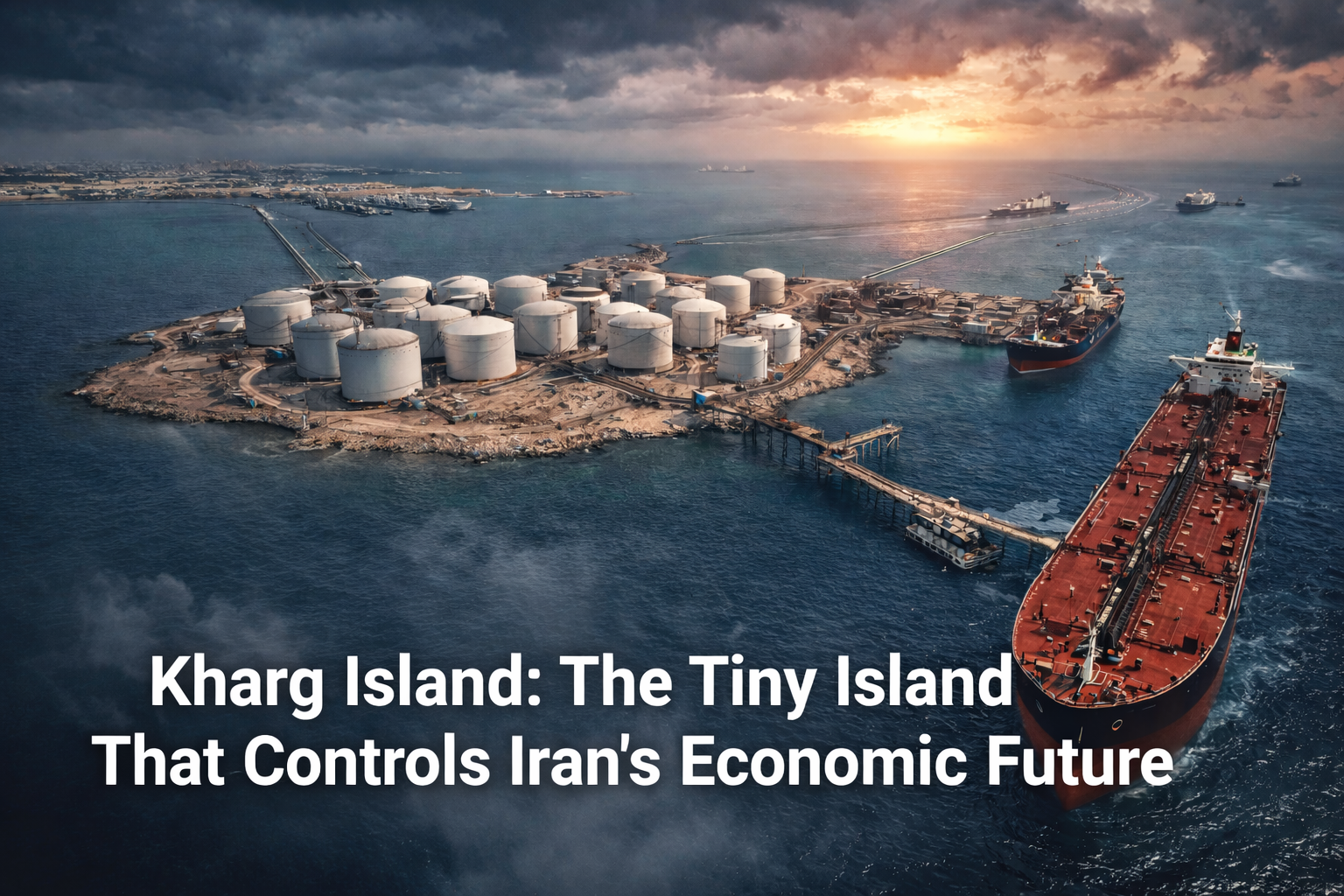
It is just 20 square kilometres of coral rock sitting in the northern waters of the Persian Gulf. There are no tourist beaches, no grand skyline, and fewer than 10,000 permanent residents. Yet on the night of March 13, 2026, this one small island became the most searched location on earth and the epicentre of a rapidly escalating war.
The United States military struck Kharg Island. And the world held its breath.
President Donald Trump announced on Truth Social: “Moments ago, at my direction, the United States Central Command executed one of the most powerful bombing raids in the History of the Middle East, and totally obliterated every MILITARY target in Iran’s crown jewel, Kharg Island.”
That single post changed the trajectory of the US-Iran war and sent oil markets into a fresh spiral. But to understand why Kharg Island matters this much, you have to go back to basics.
What Exactly Is Kharg Island?
Located roughly 25 to 28 kilometres off the southwestern coast of Iran in the Persian Gulf, Kharg Island is a coral outcrop administered by Bushehr province. It measures approximately 8 kilometres in length and 4 to 5 kilometres in width. The island has no natural scenic appeal and has been off-limits to the general public for decades, earning it the nickname the Forbidden Island.
What makes Kharg extraordinary is not its landscape but what lies beneath it and flowing through it. A dense network of subsea pipelines connects the island to three major offshore oilfields, Aboozar, Forouzan, and Dorood, as well as to the massive mainland fields of Ahvaz, Marun, and Gachsaran in Khuzestan province. All that crude oil eventually arrives at Kharg, gets stored in its vast tank farms, and is loaded onto supertankers bound for global markets.
The deep waters surrounding the island give it a geographic advantage that almost no other point on Iran’s coastline can offer. Most of Iran’s coast is shallow, making it physically impossible for massive oil tankers to dock. Kharg is one of the very few locations where supertankers can safely berth and load. This geological accident of nature turned a modest piece of land into the economic spine of an entire nation.
By the mid-2020s, the island’s terminal infrastructure could simultaneously load up to 10 supertankers at once, with a peak loading capacity of around 7 million barrels per day. In practice, Iran exports between 1.5 million and 2 million barrels per day under normal conditions, with China being the single largest buyer.
The Numbers That Tell the Real Story
No other major oil-producing country in the world concentrates nearly all of its export capacity in a single location the way Iran does at Kharg. Saudi Arabia, Kuwait, the UAE, Russia, Mexico, and Venezuela all spread their export infrastructure across multiple terminals and ports. Iran does not.
Roughly 90 percent of Iran’s crude oil exports pass through Kharg Island. Storage tanks on the island hold an estimated 30 million barrels of crude at any given time, equal to roughly 10 to 12 days of normal exports. A sustained disruption at Kharg would not just hurt Iran’s oil revenues. It would effectively shut down Iran’s primary source of government income almost overnight.
JP Morgan, in a note released early in the conflict, described Kharg as a critical vulnerability and a cornerstone of Iran’s economy and a major source of revenue for the Islamic Revolutionary Guard Corps. The bank estimated that oil prices could surge to USD 150 per barrel or more if the island’s oil infrastructure were destroyed.
For context, global oil prices were already trading above USD 100 per barrel on the day of the strikes, their second consecutive day above that threshold since the war began on February 28, 2026.
How Did This Island Become So Important?
The answer goes back to Iran’s oil boom in the 1960s. As offshore oilfields were discovered in the Persian Gulf and vast onshore reserves were found in Khuzestan, Iran needed a way to get that oil onto the international market. The coast was too shallow for supertankers. Kharg, with its naturally deep surrounding waters, was the obvious solution.
Development began under the Shah in the 1960s through an American-Iranian joint venture called the Khark Chemical Company. Infrastructure expanded rapidly through the 1970s as Iran became one of OPEC’s leading producers. Supertankers began docking at Kharg rather than at the older Abadan terminal, and the island’s strategic importance grew year by year.
The Iran-Iraq War from 1980 to 1988 gave the world its first real demonstration of just how critical Kharg was. Iraq repeatedly bombed the island’s oil infrastructure throughout the war, aiming to cripple Iran’s economy by cutting off its export revenue. By 1986, most of the terminal facilities had been severely damaged or temporarily disabled. Iran was forced to shift some shipping to smaller backup terminals at Lavan Island and Sirri Island, but those were never adequate replacements. Repair work continued long after the war ended in 1988.
After the war, rebuilding Kharg became a national priority for Iran. Over the following decades, the island was not just restored but significantly upgraded. In May 2025, less than a year before the current conflict, Iran added two million barrels of storage capacity by rehabilitating two tanks, each capable of holding one million barrels. Tehran clearly anticipated that Kharg could become a target and was trying to maximise its buffers.
Satellite imagery analysed at the start of the 2026 war revealed that Iran had been quietly reducing oil stocks at the terminal since early February, suggesting Tehran had been preparing for a possible strike for weeks before the bombs fell.
What Happened on the Night of March 13, 2026
For the first two weeks of the US-Israel military campaign against Iran, which began on February 28, Kharg Island had been left untouched. Analysts noted the restraint. Some argued it was deliberate, that the US was using the island as an unspoken hostage, a threat held in reserve to keep Iran from escalating too far.
Then came March 13.
President Trump announced on Truth Social that the US had struck every military target on Kharg Island in what he called one of the most powerful bombing raids in the history of the Middle East. He was explicit that oil infrastructure had been spared. He was equally explicit about the condition attached to that restraint.
“However, should Iran, or anyone else, do anything to interfere with the Free and Safe Passage of Ships through the Strait of Hormuz, I will immediately reconsider this decision.”
A US official separately confirmed to CNN that the military had executed a large-scale strike on Kharg, though the official declined to verify Trump’s claim that every target was destroyed. Video posted to Truth Social and later geolocated by CNN using satellite imagery showed strikes hitting airport facilities and the runway, with large explosions and thick black smoke rising over the island.
According to a US military official cited by the New York Times, the strikes targeted military sites including those storing missiles and mines. Economic and oil infrastructure was not targeted.
IRGC-affiliated Iranian state media outlet Fars News Agency subsequently reported more than 15 explosions striking military installations on the island, including air defence systems, a naval base, the airport control tower, and a helicopter hangar belonging to an oil company. Crucially, Fars also confirmed that the oil terminals themselves were not struck, an account that aligned precisely with what the Trump administration had stated.
When both sides of a conflict report the same facts independently, that is as close to confirmation as journalism gets. The military shield around Kharg had been removed. The oil infrastructure sat intact but unguarded.
Iran’s Response and the Broader Situation
Tehran did not directly respond to Trump’s announcement in the immediate hours that followed. However, Iran’s military command issued a statement through state media warning that any attack on Iranian oil and energy infrastructure would lead to retaliatory strikes on regional facilities owned by oil companies that have American shares or cooperate with the United States.
Iranian Parliament Speaker Mohammad Baqer Qalibaf had earlier warned that Iran would abandon all restraint if there were any US aggression against Iranian islands in the Persian Gulf.
Meanwhile, the broader conflict was showing no signs of cooling. The Israeli military reported carrying out more than 7,600 strikes across Iran since joint operations began on February 28, including over 2,000 against headquarters and assets of the Iranian government and roughly 4,700 against Iran’s missile programme. Defence Secretary Pete Hegseth stated that Iran’s missile and drone launch capacity had been sharply reduced. Vice President JD Vance told reporters “we know that he is hurt” regarding Iran’s new supreme leader, though the full extent of the injuries was not confirmed.
Iran continued launching strikes against Israel and Gulf countries. Explosions were reported in Qatar in the early hours of March 14, with the Qatari interior ministry saying it was evacuating certain areas as a precautionary measure. Turkey reported that an Iranian missile was intercepted by NATO air defences over its territory, the third such incident since the war began. A humanitarian crisis deepened in Lebanon as Israel continued strikes against Hezbollah, with the United Nations reporting more than 815,000 displaced people.
On the economic front, oil prices surged past USD 100 per barrel for the second day running. Treasury Secretary Scott Bessent said the US Navy could begin escorting tankers through the Strait of Hormuz, a statement Trump later confirmed when he told reporters that naval escorts would begin soon. France separately announced it was developing plans to form a coalition to secure the strait once the security situation stabilised.
Why the Strait of Hormuz Holds Everyone Hostage
The Strait of Hormuz is a narrow waterway between Iran and Oman that connects the Persian Gulf to the open ocean. Roughly 20 percent of global oil and liquefied natural gas passes through it. In 2024, approximately 20 million barrels of oil per day transited the strait.
Iran has been using the strait as a weapon. Since the start of the conflict on February 28, Iranian attacks on tankers and vessels have all but halted commercial shipping through the waterway, according to the International Energy Agency’s executive director. That disruption is the main reason oil prices have spiked so sharply.
The strike on Kharg is directly connected to this. Trump’s message was unmistakable: the oil infrastructure at Kharg still stands, but if Iran keeps blocking the strait, that could change. It is coercive signalling through military force, using the island as both a warning and a bargaining chip.
Former US Army brigadier general Mark Kimmitt, speaking to CNN after the strikes, described the situation plainly. He said the US is holding the island hostage to ensure that Iran allows ships through the strait, but warned that if the oil infrastructure itself gets targeted, Iran will attack the rest of the energy infrastructure in the Middle East, and at that point, oil prices will go out of control.
What Could Happen Next?
There are several plausible directions from here, none of them simple.
If Iran continues blocking the Strait of Hormuz, Trump has now publicly committed to reconsidering his decision to spare Kharg’s oil terminals. A strike on those terminals would almost certainly trigger the most severe phase of the conflict yet. Iran has explicitly threatened to retaliate against regional oil facilities linked to American interests. That could mean strikes on Saudi Arabian, Emirati, or Kuwaiti energy infrastructure, sending global oil markets into a period of extreme volatility.
If Iran backs down on the strait and allows free passage, it loses a key piece of leverage and faces enormous domestic political pressure. For a government already under siege, that is a difficult calculation.
There is also the question of what comes next militarily on the island itself. Reports from earlier in March cited Trump administration officials telling Axios that seizing Kharg was under active discussion. Experts have consistently argued that any attempt to physically capture the island would require a significant ground troop deployment. The Pentagon announced it was sending the USS Tripoli assault ship with approximately 2,500 Marines aboard to the region, a development that now looks less like preparation and more like strategic positioning.
What is clear is that the United States has now crossed a line it spent two weeks avoiding. Kharg Island is no longer untouched. Every military installation on it, according to both American and Iranian accounts, is gone. The oil terminals sit intact for now, but their survival depends entirely on what Tehran decides to do next.
Our Perspective
What we are watching in real time is a form of warfare that uses economic infrastructure as both weapon and shield. The United States has deliberately left Kharg’s oil terminals standing not out of mercy, but out of calculation. Destroying them would spike global oil prices to levels that would hurt American consumers, destabilise allies, and hand Iran a narrative of victimhood on the world stage.
Trump’s approach has a logic to it, even if it is brutal. By taking out every military installation while leaving the economic infrastructure untouched, he has sent a message that says: we can hurt you more, but we are choosing not to. Yet. That is coercive diplomacy at its most naked.
The problem is that Iran is in a corner. Its new supreme leader is reportedly injured. Its missile capacity has been degraded. Its economy is bleeding. In that situation, rational calculation sometimes gives way to escalation, because a government fighting for survival often has less to lose than one that is comfortable.
The strike on Kharg Island was not an ending. It was a warning shot at the most sensitive nerve in Iran’s body. Whether Tehran chooses to flinch or escalate will determine whether the world’s oil supply stabilises or enters a prolonged crisis. We will be watching closely and reporting every development as it happens.
Frequently Asked Questions
Q1. Why is Kharg Island so important to Iran?
Kharg Island handles roughly 90 percent of all Iranian crude oil exports. Its deep surrounding waters allow supertankers to dock, which most of Iran’s shallow coastline cannot support. Without Kharg functioning, Iran effectively loses its ability to earn oil revenue on a meaningful scale.
Q2. Did the US attack Kharg Island’s oil terminals?
No. According to both US officials and IRGC-affiliated Iranian state media, the strikes targeted military infrastructure only, including air defence systems, missile storage, a naval base, the airport control tower, and a helicopter hangar. The oil terminals, pipelines, and storage tanks were not struck.
Q3. What has Iran said in response to the strikes?
Tehran’s military command warned that any attack on Iranian energy infrastructure would trigger retaliatory strikes on regional oil facilities connected to American interests. Iran’s parliament speaker had earlier warned of abandoning all restraint if Iranian islands were attacked.
Q4. How did the strikes affect oil prices?
Brent crude was already trading above USD 100 per barrel before the Kharg announcement. Analysts warn that prices could rise to USD 150 per barrel or more if the oil terminals themselves are destroyed.
Q5. Has Kharg Island been attacked before?
Yes. During the Iran-Iraq War from 1980 to 1988, Iraqi aircraft repeatedly bombed the island’s oil infrastructure. By 1986, most terminal facilities had been severely damaged. Iran was forced to use backup terminals at Lavan and Sirri islands during repairs.
Q6. What is the Strait of Hormuz and why does it matter?
The Strait of Hormuz connects the Persian Gulf to international shipping lanes. Approximately 20 percent of global oil and LNG passes through it daily. Iran has been disrupting tanker traffic through the strait since the start of the conflict, causing energy prices to surge globally.
Q7. Could the US seize Kharg Island?
The Trump administration discussed the possibility in early March 2026. However, most military analysts say seizing the island would require a substantial ground force. The Pentagon is moving the USS Tripoli assault ship with approximately 2,500 Marines to the region, but no official seizure operation has been announced.
Q8. What happens if Kharg’s oil terminals are destroyed?
Iran’s oil export capacity would be crippled for potentially years. Global oil prices would likely surge sharply, and Tehran has warned it would retaliate against energy infrastructure across the region that is connected to American interests.