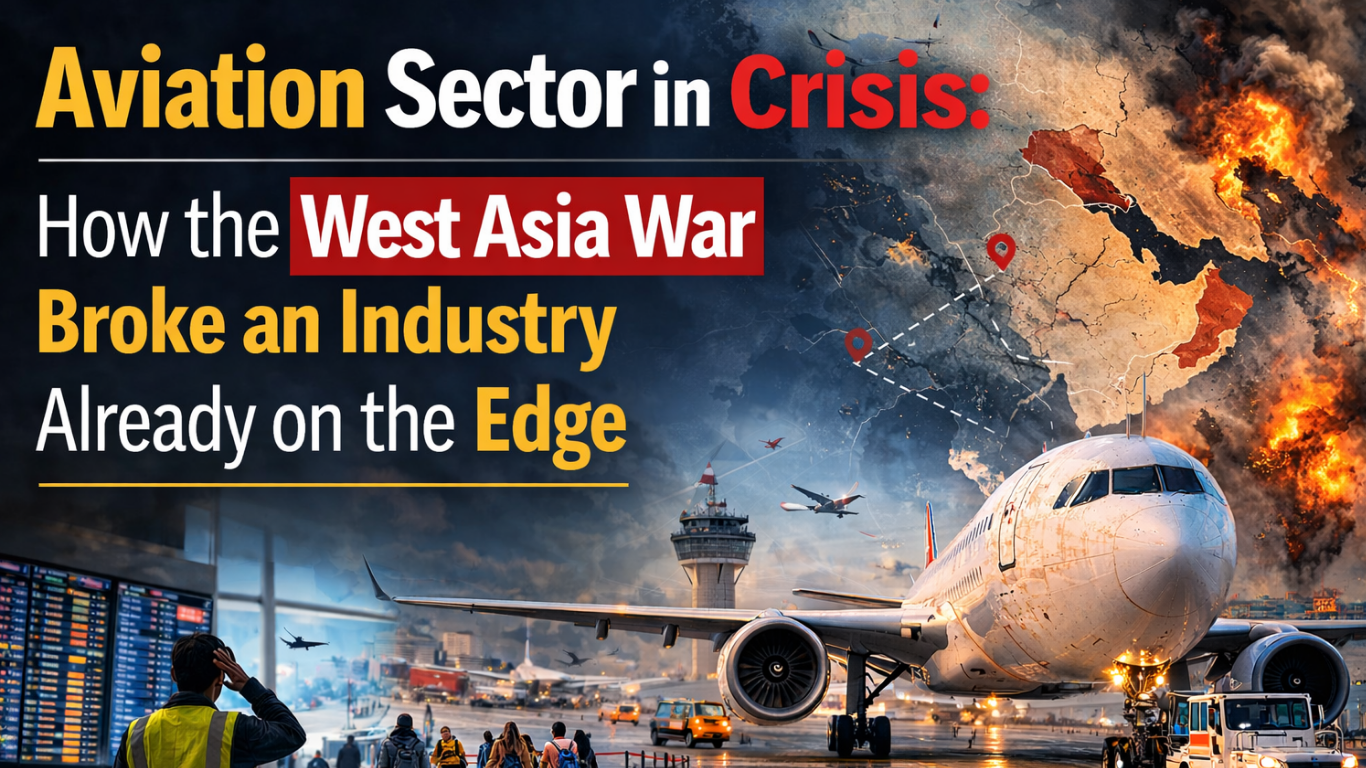
Aviation News: The global aviation industry entered 2026 in a fragile state. Aircraft shortages, labour gaps, ageing fleets and rising costs were already quietly squeezing airlines from every direction. Then the West Asia conflict erupted – and what was already a difficult situation became, for many carriers, an outright crisis. Jet fuel prices hit levels not seen in years. Airspace over one of the world’s busiest aviation corridors effectively closed overnight. Thousands of flights were cancelled. And passengers across the globe found themselves stranded, rerouted or staring at ticket prices that had doubled in a matter of days.
This story is not just about a war disrupting flights. It is about a war arriving at exactly the wrong moment for an industry that had very little room to absorb the shock.
The Industry Before the War – A Fragile Recovery Built on Sand
The aviation industry came into 2026 in a peculiar position. On paper, things looked good. Passenger demand was strong, revenues were high and the International Air Transport Association had forecast a net industry margin of 3.9% for the year. But underneath those headline numbers, serious cracks were already showing.
Aircraft delivery backlogs had reached a historic high of over 17,000 planes globally – equal to nearly 60% of the entire active fleet. Boeing and Airbus, the two dominant manufacturers, were struggling with supply chain issues that showed no signs of resolving before 2031 at the earliest. The average age of the global fleet had risen to 15.1 years, the highest ever recorded. Airlines were forced to keep older, less fuel-efficient planes flying simply because newer ones were not arriving on schedule. Supply chain disruptions had already cost the industry over 11 billion dollars in additional expenses in 2025 alone.
Labour was another open wound. Labour costs became the single largest cost component for airlines in 2026 at 28% of total operating expenses, overtaking fuel for the first time. A global pilot shortage was worsening with Oliver Wyman projecting the gap at 17,000 pilots by 2032 – with 2026 identified as the year the shortage would be most acute. Ground crew, maintenance technicians and air traffic controllers were in equally short supply. Over 90% of air traffic control centres in the United States were operating below recommended staffing levels.
In short, the aviation industry entered this crisis with older planes, too few pilots, a supply chain that could not keep up and profit margins thin enough that any serious external shock could wipe them out entirely.
The Fuel Shock – Numbers That Are Hard to Comprehend
Before the first strikes on Iran in late February 2026, jet fuel was trading at around 85 to 90 dollars per barrel. Within days of the conflict escalating, that number shot to between 150 and 200 dollars per barrel according to Air New Zealand. At its peak, jet fuel hit a record 225.44 dollars per barrel on March 5 – a 72% surge in just a matter of days. Spot prices at the US Gulf Coast crossed 4.12 dollars per gallon, a level not seen in nearly four years.
To understand why this matters so much to airlines, consider that fuel typically accounts for 20 to 30% of an airline’s total operating costs. For Indian carriers like Air India, that figure is even higher – closer to 40%, because of high excise duties and VAT on aviation turbine fuel in major Indian cities. When fuel costs nearly double in a week, the financial mathematics of running an airline fall apart almost instantly.
Airlines with strong hedging programmes – carriers that had pre-purchased fuel at fixed prices – were somewhat shielded. Lufthansa and Ryanair managed to avoid passing costs directly to consumers in the short term because of their hedging positions. But the global industry had been moving away from aggressive hedging in recent years, meaning most carriers faced this shock with full direct exposure. The situation was made worse by the fact that Kuwait, one of the major jet fuel exporters to north-west Europe, faced output cuts due to the conflict, tightening regional supply further. IATA reported that tanker movements through the Strait of Hormuz had fallen by an estimated 70 to 80% since the conflict escalated Haaretz, directly strangling the supply of refined products that refiners in Europe and Asia depend on.
The Airspace Crisis – When the Sky Itself Closes
The Middle East is not just a fuel source for aviation. It is the geographic heart of global air travel. Flights between Europe and Asia, between Australia and the United Kingdom, between India and North America – nearly all of them pass over or through the airspace of Gulf countries and Iran. When that airspace closed or became restricted, the disruption was not regional. It was immediately global.
By early March, the conflict had forced the closure or severe restriction of primary transit hubs in Dubai, Doha and Abu Dhabi. Over 21,300 flights were cancelled globally in the first week of March alone. Planes arriving in Dubai were briefly placed in holding patterns due to missile threat warnings. Crew members and aircraft found themselves stranded in affected regions, causing knock-on chaos for flight schedules thousands of miles away. Austrian Airlines flew a dedicated crew evacuation flight from the region just to get its staff home safely.
The rerouting problem is significant and expensive. Emirates, Qatar Airways and Etihad typically jointly account for about one third of passenger traffic between Europe and Asia. With those hubs restricted, airlines had to find alternative paths – longer paths. Adding several hours to a long-haul flight means burning significantly more fuel. It also means crew members hit their maximum legal flying hours faster, requiring technical stops at cities like Muscat and Istanbul that were never in the original plan. Landing fees, ground handling costs and crew overtime all pile on top of the fuel bill.
European airlines were particularly exposed because they had already been flying longer routes since 2022 to avoid Russian airspace. With even less available airspace now, carriers described their operational environment as exceptionally challenging. EASA classified 11 West Asian airspaces as high-risk and prohibited flights at any altitude – a ruling that grounded IndiGo’s leased Boeing 787 Dreamliner fleet entirely because those Norwegian-registered aircraft fell under EASA jurisdiction.
The Fare Surge – Who Is Actually Paying for All of This
The short answer is: passengers. When capacity drops and costs surge, airline pricing algorithms do what they are designed to do – they push fares to the maximum level the market will bear. Carriers’ algorithms automatically push prices to the maximum willingness-to-pay threshold when seat scarcity rises. So passengers end up paying not just for the higher fuel cost but for the reduced availability of seats caused by cancellations and rerouting.
Qantas, SAS and Air New Zealand announced airfare hikes citing the abrupt spike in fuel costs, with Air New Zealand also suspending its entire financial outlook for 2026 due to uncertainty over the conflict. Asia-Europe routes, which are among the world’s busiest, saw fares climb sharply as capacity constraints created genuine scarcity. Cathay Pacific added flights to London and Zurich specifically to capture the overflow demand from disrupted Middle East carriers.
For Indian travellers, the situation carried a particular sting. Indian airlines were already flying longer routes due to the ongoing restrictions on Pakistani airspace, which adds up to three hours and nearly 29% more fuel on certain European routes. The West Asia crisis added another layer on top of an already expensive operational reality. With the rupee falling to record lows against the dollar and fuel priced in dollars, the compounding effect on Indian carriers was severe. The double blow of currency weakness and fuel price spikes made every international flight operated by Indian airlines more expensive before a single ticket was even sold.
The Indian Aviation Industry – A Particular Vulnerability
India’s aviation market deserves its own discussion because the pressures here were amplified in ways that did not apply equally everywhere else. Air India and IndiGo are both in the middle of significant international expansion programmes – precisely the kind of growth plans that require stable fuel prices, accessible airspace and a steady rupee. The crisis upended all three conditions simultaneously.
IndiGo faced a specific and unusual problem that went beyond fuel. Its six leased Boeing 787 Dreamliners, acquired from Norse Atlantic Airways, were registered in Norway and therefore directly subject to EASA directives. When EASA banned flights over 11 West Asian airspaces, those planes could not fly – full stop. IndiGo’s wide-body European operations were grounded at a time when the airline had been betting heavily on international expansion as its next growth chapter.
Air India pushed to gain access to Chinese airspace as an alternative routing to Europe, but the complexity of obtaining such clearances and the diplomatic sensitivities involved meant that was never a quick or easy fix. With aviation turbine fuel taxed at significantly higher rates in India than the global norm and with the rupee weakening, the cost pressures that crushed margins for European carriers hit Indian carriers even harder in proportional terms.
What Happens Next – Three Possible Futures
The aviation industry’s path from here depends almost entirely on one variable: how long the conflict lasts. This is not a situation with a clean industrial solution. No amount of hedging, rerouting or cost-cutting can substitute for a return to normal in the region.
If the conflict is resolved within weeks, the industry faces a difficult but survivable quarter. Fuel prices would normalise, airspace would reopen and the backlog of stranded passengers would gradually clear. Airlines with strong balance sheets would absorb the losses and move on. The scars would be visible in quarterly earnings but the structural damage would be limited.
If the conflict extends into months, the picture becomes significantly darker. Industry analysts say a prolonged crisis would force airlines to incorporate increased operating costs and reduced effective aircraft capacity back into ticket prices on a sustained basis. Smaller and more financially fragile carriers that lack hedging programmes, cash reserves or government backing could face insolvency. The low-cost carrier model, which depends on very thin margins and very high aircraft utilisation, is particularly vulnerable to a sustained high-fuel environment.
The long-term structural change this crisis could accelerate is the adoption of Sustainable Aviation Fuel. When conventional fuel becomes this volatile and this expensive, the business case for SAF shifts from a sustainability argument to a hard financial one. Governments and airlines that were moving slowly on SAF investment may now accelerate. Similarly, the crisis has renewed urgency around fuel-efficient new aircraft – but with the Boeing and Airbus backlog sitting at 17,000 planes, that renewal cannot happen quickly regardless of intent.
FAQs
Why did jet fuel prices rise so sharply so quickly?
The Strait of Hormuz disruption reduced tanker traffic by 70 to 80% almost overnight. The Middle East supplies a significant share of the world’s refined petroleum products including jet fuel. When that supply suddenly shrinks while demand stays the same, prices spike fast.
Are all airlines equally affected?
No. Airlines with strong fuel hedging programmes were somewhat protected in the short term. Airlines flying through or near Gulf hubs suffered the most operationally. Indian carriers faced a double blow from airspace restrictions and a weakening rupee on top of higher fuel costs.
How much have airfares increased?
It varies by route, but Asia-Europe and Australia-Europe routes have seen the sharpest increases due to capacity constraints and rerouting. Some fares on these routes doubled within days of the conflict escalating.
What is a fuel hedge and why does it matter now?
A fuel hedge is a financial contract that lets an airline lock in fuel at a fixed price for a future period. Airlines that hedged 50 to 80% of their fuel needs before the crisis were insulated from the worst of the spike. Airlines that had moved away from hedging faced the full impact of prices that nearly doubled.
Will flight prices come down again?
Yes, if the conflict resolves and airspace reopens. The catch is the timeline. Even after a ceasefire, rerouting habits tend to persist for months as airlines and crews adjust back to normal patterns. A full return to pre-crisis fares could take several months even in an optimistic scenario.
Is SAF a realistic near-term solution?
Not yet. SAF currently represents just 0.8% of total aviation fuel consumption and the incremental cost over conventional fuel is significant. It is a long-term answer, not a crisis response tool. But sustained high conventional fuel prices make the investment case stronger and could accelerate production capacity over the next several years.